Fifty years of caring for the women of Rangpur
Since 1975, the Department of Obstetrics & Gynaecology has grown into a 140-bed tertiary referral centre with four clinical units, an outpatient department, specialized clinics, a One-Stop Crisis Centre and a Model Family Planning Clinic.
A tertiary centre for Rangpur Division
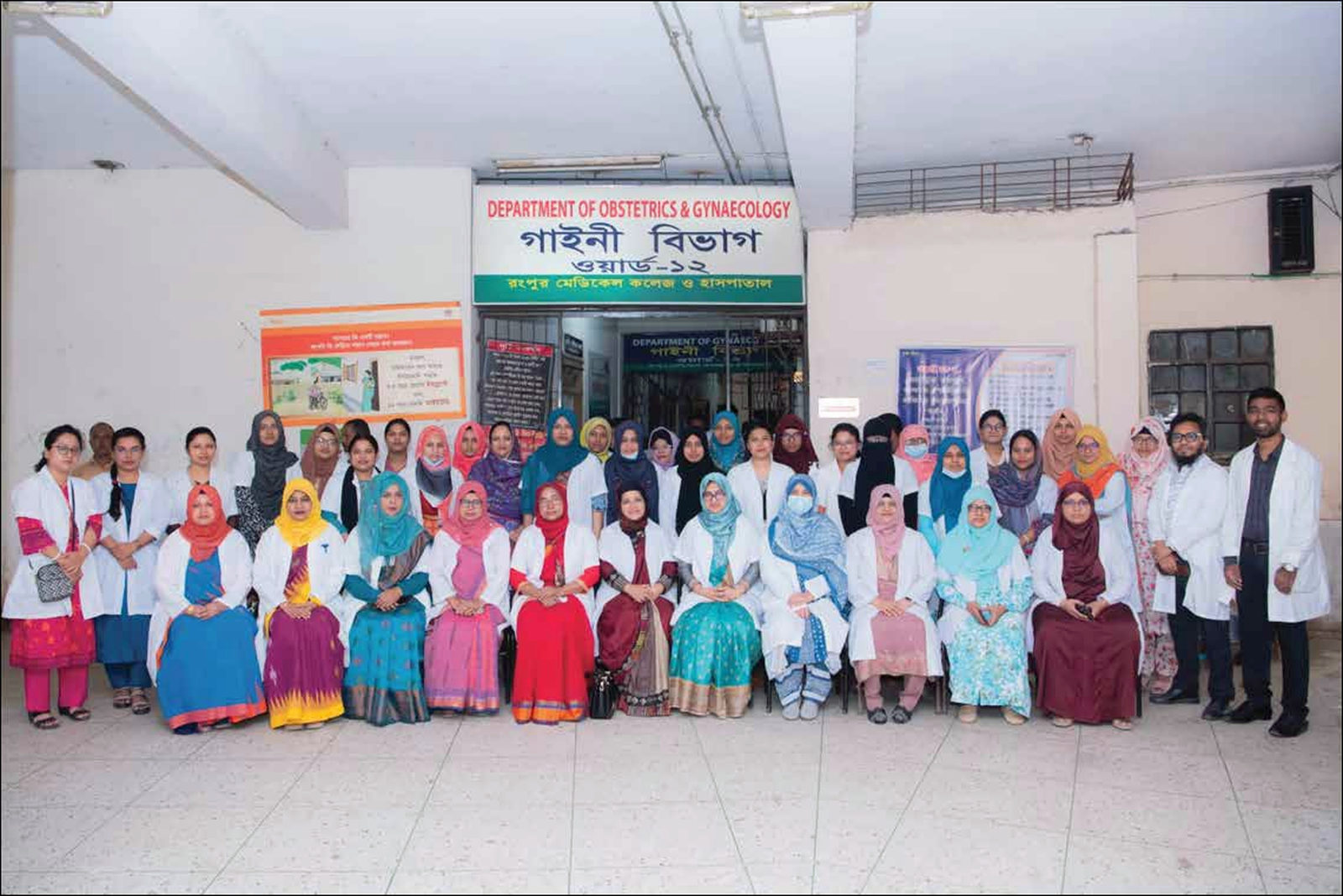
The inpatient department is on the 3rd floor of a four-storied building and admits patients round the clock. It has 140 beds, 14% of the hospital’s 1,000 beds: 70 obstetric and 70 gynaecology beds, plus a 5-bed labour room.
Many complicated cases are referred from surrounding district hospitals, so the department manages a high volume of obstetric emergencies such as eclampsia, haemorrhage and obstructed labour, alongside routine care, teaching and research.
Vision
To be a centre of excellence in Obstetrics and Gynaecology, providing safe, evidence-based, respectful and equitable women-centred healthcare throughout the reproductive life course, while fostering excellence in medical education, postgraduate training, research, innovation and continuous quality improvement.
Our values: Safety, Respect & Dignity, Evidence-Based Practice, Teamwork, Integrity & Accountability, Lifelong Learning.
Mission
The Department of Obstetrics & Gynaecology is committed to:
- 1
Comprehensive Women-Centred Healthcare +
Provide accessible, safe, compassionate and evidence-based care to women throughout the reproductive life course, including antenatal, intrapartum and postnatal care, high-risk pregnancy management, family planning, infertility care, gynaecological disorders, reproductive health and emergency services.
- 2
Safe and High-Quality Obstetric Care +
Strengthen the quality and safety of maternal and newborn care through standardized clinical protocols, timely recognition and management of obstetric emergencies, effective referral and multidisciplinary teamwork, with particular emphasis on reducing preventable maternal and perinatal morbidity and mortality.
- 3
Respectful and Patient-Centred Care +
Promote dignity, privacy, confidentiality, informed choice, effective communication and respectful care for every woman and her family, irrespective of socioeconomic status, geographical background or clinical condition.
- 4
Excellence in Medical Education and Training +
Provide structured, competency-based undergraduate and postgraduate education through lectures, bedside teaching, clinical demonstrations, case presentations, simulation, procedural training, seminars, journal clubs and supervised clinical practice.
- 5
Development of Competent and Ethical Specialists +
Train undergraduate students, interns, MS and FCPS trainees and other healthcare professionals to develop appropriate knowledge, clinical skills, procedural competence, decision-making ability, professionalism, communication skills and ethical practice.
- 6
Evidence-Based Practice and Clinical Research +
Promote clinical research, thesis and dissertation work, collaborative research and evidence-based practice addressing the priority maternal, reproductive and gynaecological health needs of the region.
- 7
Continuous Quality Improvement and Patient Safety +
Establish a culture of continuous quality improvement through regular review of clinical statistics, maternal and perinatal outcomes, mortality and morbidity, adverse events, clinical audits, Ward Improvement Team activities, implementation of corrective measures and monitoring of outcomes.
- 8
Innovation and Advanced Clinical Services +
Develop and strengthen specialized and advanced services in areas such as high-risk pregnancy, fetal medicine, infertility and reproductive medicine, minimal access gynaecological surgery, hysteroscopy, urogynaecology, obstetric critical care and other emerging areas of women's health.
- 9
Interprofessional and Multidisciplinary Collaboration +
Promote effective collaboration among obstetricians, gynaecologists, anaesthesiologists, neonatologists, nurses, midwives, laboratory and diagnostic services, social services and other relevant disciplines to ensure coordinated and comprehensive patient care.
- 10
Professionalism and Lifelong Learning +
Foster integrity, accountability, empathy, teamwork and professional responsibility among all members of the department and encourage continuous professional development, self-directed learning and adoption of current scientific evidence.
- 11
Community and Social Responsibility +
Respond to the priority health needs of women and families in Rangpur and the wider northern region through equitable service delivery, health education, reproductive health services, prevention-oriented care and appropriate community engagement.
- 12
Data-Driven Governance and Accountability +
Maintain accurate clinical, academic and research documentation and use reliable data, measurable indicators and transparent reporting to guide departmental planning, decision-making, quality improvement and future development.
What we aim to achieve
A. Clinical Care
- To provide round-the-clock comprehensive obstetric and gynaecological services for routine, high-risk and emergency patients.
- To improve maternal and neonatal outcomes through timely diagnosis, evidence-based management, standardized emergency response and effective multidisciplinary care.
- To strengthen management systems for major obstetric emergencies including postpartum haemorrhage, hypertensive disorders of pregnancy, obstetric haemorrhage, sepsis, obstructed labour, fetal compromise and other life-threatening conditions.
- To promote safe and appropriate vaginal birth while ensuring that caesarean section and operative interventions are undertaken on sound clinical indications.
- To strengthen antenatal, intrapartum, postnatal and newborn care as a continuum rather than as isolated services.
- To expand specialized services including High-Risk Pregnancy, Infertility, Fetal Medicine, Urogynaecology, Minimal Access Surgery and other priority areas of women's health.
- To strengthen obstetric critical care capacity, including development and effective utilization of the Obstetric ICU and enhanced emergency response systems.
- To modernize and continuously improve labour-room services, infrastructure, equipment, protocols and teamwork.
Units & organogram
The Head of the Department leads four inpatient units, the outpatient department, the Model Family Planning Clinic and the One-Stop Crisis Centre.
Unit I
Dr. Most. Safura Khatun
Unit Head
- 1 Assistant Professor
- 1 Assistant Professor (c.c)
- 2 Junior Consultants
- 2 Registrars
- 2 Assistant Registrars
- 5 Medical Officers
Unit II
Dr. Mst. Rawshon Ara Begum
Unit Head
- 1 Associate Professor (c.c)
- 1 Assistant Professor (c.c)
- 1 Junior Consultant
- 1 Registrar
- 2 Assistant Registrars
- 4 Medical Officers
Unit III
Dr. Mahabuba Khatun
Unit Head
- 1 Assistant Professor
- 2 Junior Consultants
- 1 Registrar
- 1 Assistant Registrar
- 3 Medical Officers
Unit IV
Dr. Mst. Khodeza Khatun
Unit Head
- 1 Assistant Professor (c.c)
- 2 Junior Consultants
- 1 Registrar
- 1 Assistant Registrar
- 3 Medical Officers
Outpatient Department
- 2 Resident Surgeons
- 3 Medical Officers
Model Family Planning Clinic
- 3 Medical Officers
One-Stop Crisis Centre (OCC)
- 1 Resident Surgeon
- 3 Medical Officers
In addition, 33 trainee doctors are currently training in the department: 13 MS course doctors assigned by BMU and 20 Non-Government Trainee Doctors (NGTD) assigned by BCPS for FCPS Part-2 training, plus 1 Honorary Doctor.
Hospital beds
Most of the time bed occupancy remains 100%. Extra patients are provided with extra beds.
Former Heads of the Department
Dr. Abdul Bayes Bhuyan
Associate Professor
1975 – Mar 1977
Nov 1977 – Dec 1982
Prof. Zubaid Hossain
Apr 1977 – Oct 1977
Prof. Altaf Hossain Talukdar
01-01-1983 – 14-02-1987
Prof. T.A Chowdhury
15-02-1987 – 07-04-1987
Dr. Nurjahan Begum
Associate Professor (c.c)
08-04-1987 – 15-08-1987
Dr. AKM Shahab Uddin
Associate Professor
16-04-1987 – Mar 1993
Prof. Azizul Islam
22-06-1994 – 17-01-2010
Prof. Ferdousi Sultana
18-01-2010 – 19-03-2010
12-02-2011 – 19-06-2018
Prof. Farhana Dewan
20-03-2010 – 11-02-2011
Prof. Mst. Kamrun Nahaer
20-09-2018 – 04-02-2019
29-05-2019 – 22-09-2022
Prof. Anisa Begum (c.c)
05-02-2019 – 28-05-2019
Prof. Sharmin Sultana
23-09-2022 – 19-01-2025